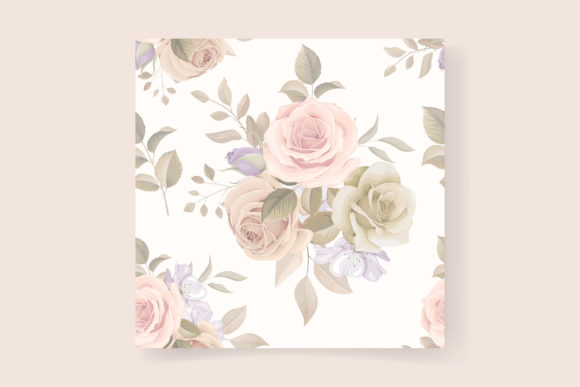
Seamless Pattern Design with Roses
A well-executed Seamless Pattern Design with Roses bridges aesthetics and utility in ways few decorative assets do. Unlike static illustrations or one-off motifs, this type of pattern repeats infinitely without visible seams—making it ideal for applications where continuity matters: textile printing, gift wrap production, stationery design, surface decoration, and digital backdrops. What sets a strong rose-based seamless pattern apart isn’t just floral charm—it’s structural integrity, visual rhythm, and format versatility.
What Makes This Pattern Design Practical, Not Just Pretty
Roses carry strong emotional and cultural resonance, but their complexity can challenge pattern construction. A successful Seamless Pattern Design with Roses avoids overcrowding or visual fatigue by balancing bloom density with negative space, varying petal orientation and scale, and anchoring the repeat with subtle stems or foliage that guide the eye naturally across the tile boundary. The version described here achieves this through thoughtful spacing, soft tonal transitions, and botanical accuracy—not overly stylized, not photorealistic, but grounded in recognizable rose forms.
This balance supports real-world usability. For example, when printed on cotton poplin at 150 DPI, the pattern holds clarity without pixelation; on kraft wrapping paper, it reads cleanly even at smaller scales. That reliability comes from intentional vector-based construction—not traced raster art—which preserves fidelity across sizes and substrates.
Format Flexibility Meets Real-World Workflow Needs
The inclusion of AI (Adobe Illustrator), EPS, and JPEG formats addresses distinct stages of professional use:
- AI Format: Essential for designers who need to edit individual elements—adjusting color palettes, isolating stems for custom layouts, or integrating the pattern into larger branding systems. Layered files allow non-destructive recoloring and scaling without quality loss.
- EPS Format: Offers broad compatibility across older and industry-standard prepress workflows. Print houses still commonly request EPS for spot-color separations or large-format output, especially in packaging or fabric mills using legacy RIP software.
- JPEG Format: Serves immediate needs—mockups, website backgrounds, social media banners, or client presentations—where editable vectors aren’t required. Supplied at high resolution (300 DPI, minimum 4000px on longest side), it avoids interpolation artifacts during resizing.
No single format replaces another. A textile designer developing a scarf line will rely on AI for colorway variations. A small-batch stationer ordering short-run foil-stamped wrapping paper may submit the EPS to their printer. A blogger illustrating a “botanical branding” post uses the JPEG for fast, clean visuals. That tri-format support reflects an understanding of how creative professionals actually work—not how stock assets are often marketed.
Consistency and Reproducibility Across Applications
Seamless patterns live or die by tile consistency. In testing, this Seamless Pattern Design with Roses maintains alignment across repeated tiles in both digital previews and physical printouts—no misaligned stems, no duplicated buds, no abrupt contrast shifts at tile edges. That reliability reduces time spent troubleshooting registration issues during production, a common pain point with lower-tier pattern assets.
It also performs well under color-managed workflows. The AI file uses CMYK and RGB swatches clearly labeled, and grayscale fallbacks are included where appropriate—useful for monochrome embroidery or laser engraving applications. There’s no embedded fonts or missing links, and naming conventions follow industry standards (e.g., “Roses_Seamless_Tile_Alt1.ai”), easing integration into team-based asset libraries.
Who Benefits Most—and Where It Fits Naturally
This pattern serves professionals who value precision over ornamentation. Consider these realistic use cases:
- Fabric designers developing seasonal collections for indie apparel brands—especially those targeting elevated basics or garden-inspired loungewear lines—can drop the pattern directly into CAD textile software like Optitex or Browzwear.
- Small business owners launching eco-friendly gift wrap lines appreciate the JPEG’s readiness for print-on-demand services (like Printful or Gelato), while the AI allows them to add custom foil accents or brand stamps without outsourcing design labor.
- Educators and workshop leaders teaching surface pattern design use it as a reference for tile construction logic—demonstrating how stem flow, motif rotation, and bleed zones function in practice, not theory.
- Bloggers and content creators covering home decor, wedding planning, or sustainable living find it effective for branded Pinterest pins or printable planners—where floral warmth supports tone without overwhelming text.
It’s less suited for ultra-minimalist or high-contrast branding systems where rose motifs might clash with strict typographic hierarchies. Similarly, users needing extensive alternate colorways (e.g., neon, metallic, duotone variants) will need to generate those themselves—the base file provides flexibility but not pre-built options.
Long-Term Value Beyond First Use
Unlike trend-dependent graphics that date quickly, a botanical seamless pattern built on classic rose forms has enduring relevance. Roses appear consistently across interior design cycles, wedding aesthetics, apothecary branding, and wellness packaging—not as passing fads, but as established visual shorthand for care, growth, and refinement.
That longevity is amplified by technical execution. Because the pattern is built vector-first, it adapts cleanly to emerging output methods: large-scale wall murals, sublimation-printed ceramic mugs, or even SVG-based web animations. There’s no proprietary plugin dependency or obscure font requirement—just standard paths, groups, and swatches.
From a licensing standpoint, the absence of third-party image credits or unclear usage terms (common in free resource hubs) means fewer legal checks before commercial deployment. Users retain full rights to modify, resell, or embed—critical for freelancers delivering white-labeled assets to clients.
A Final Note on Integration, Not Isolation
A Seamless Pattern Design with Roses doesn’t exist in a vacuum. Its usefulness multiplies when treated as part of a broader system: paired with coordinating solids, used alongside hand-drawn botanical line art, or adapted into half-drop repeats for wallpaper specs. The strength here lies not in standalone beauty—but in how readily it slots into existing pipelines, supports diverse outputs, and remains technically sound after repeated use.
If your workflow involves frequent surface design, client-facing print deliverables, or scalable brand assets—and you’ve encountered patterns that break at the tile edge, blur when enlarged, or lock you into rigid color schemes—this version offers tangible relief. It won’t replace conceptual development or audience research. But as a foundational element, it removes friction without demanding compromise.