Christmas Heart Seamless Pattern
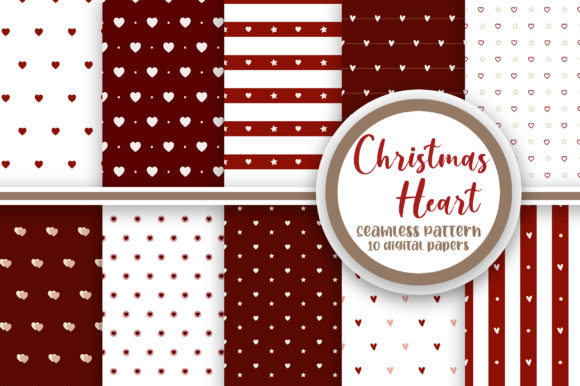
The Christmas Heart Seamless Pattern is a curated digital design resource consisting of ten high-resolution JPG files, each sized at 12 × 12 inches (3600 × 3600 pixels) and rendered at 300 dpi. As a seamless pattern, it repeats smoothly without visible seams or breaks—making it suitable for applications where consistent, tileable background coverage is required. The design centers on heart motifs interpreted through a festive lens: think stylized red-and-green hearts, subtle snowflakes interwoven with heart shapes, or gold-foiled hearts against deep navy or cream backdrops. These are not isolated clipart elements but cohesive, repeatable surface patterns intended for professional and hobbyist use alike.
People researching the Christmas Heart Seamless Pattern typically fall into two broad categories: those with a defined project in mind—such as designing holiday greeting cards, printable wrapping paper, or branded social media banners—and those exploring pattern libraries for seasonal creative work. In both cases, the evaluation hinges less on novelty and more on practical compatibility: Does this pattern align with file format requirements? Does its color palette match existing brand guidelines? Can it scale predictably across print and digital outputs?
One key benefit of the Christmas Heart Seamless Pattern is its technical readiness. Each file is delivered as a JPG at full print resolution, eliminating the need for users to convert, resample, or troubleshoot vector-to-raster issues. For designers working in tools like Adobe Photoshop, Canva, or Affinity Designer, this means immediate drag-and-drop usability. The 300 dpi resolution supports sharp output on physical media—including letterpress invitations, fabric transfers, and large-format banners—without requiring upscaling that could compromise clarity. Additionally, the inclusion of ten distinct variations offers flexibility: one might suit a minimalist craft project, while another—with bolder contrast and denser repetition—may better serve a retail window display.
However, several considerations affect suitability. Because these are raster (JPG) files—not vector or layered PSDs—they cannot be edited at the element level. Users cannot recolor individual hearts, adjust spacing between motifs, or isolate components for custom arrangements. If a project demands precise color matching to a Pantone standard or requires transparency (e.g., for overlaying text), the lack of alpha channels in JPG format becomes a functional limitation. Similarly, while the 3600 × 3600 pixel dimension accommodates most standard print sizes, users planning ultra-large applications—such as wall murals exceeding 24 inches in height—should verify tiling behavior at scale, as minor alignment inconsistencies may become visible only when repeated dozens of times.
The Christmas Heart Seamless Pattern is a strong fit when the goal is efficiency and consistency in time-bound seasonal work. Crafters producing batches of handmade ornaments or gift tags benefit from ready-to-print backgrounds that eliminate layout guesswork. Small businesses launching limited-edition holiday packaging can apply the pattern across labels, boxes, and web assets with visual continuity. Educators preparing classroom decorations or holiday-themed worksheets also find value in the straightforward file structure—no design software expertise is needed to insert the pattern into a Word document or Google Slides template.
Conversely, alternatives may be preferable in certain scenarios. Designers needing full creative control—such as adjusting motif size, rotating elements, or integrating gradients—will likely prefer vector-based pattern swatches (e.g., AI or SVG files) or editable Photoshop patterns with layer groups. Those building long-term brand asset libraries may prioritize scalable vector formats for future reuse beyond the current season. Likewise, if a project calls for monochrome or pastel aesthetics outside the included color range—say, sage green and ivory instead of traditional red-and-green—a different pattern set with broader palette options would better meet the need. It’s also worth noting that some users may already own design software with built-in pattern generators; for simple geometric or low-detail repeats, generating a custom heart pattern in-house could offer greater specificity than licensing a pre-made set.
When evaluating whether the Christmas Heart Seamless Pattern meets your needs, begin by listing your core constraints: required file format, minimum resolution, color accuracy needs, and intended output medium. If your workflow relies heavily on raster editing and you need dependable, festive, tileable backgrounds within a narrow timeframe, this set delivers predictable results. If your goals include iterative experimentation—changing spacing, blending modes, or layering multiple patterns—the absence of layered source files may slow progress. Consider also how many variants you realistically need: ten options provide breadth, but if only two or three align with your aesthetic or branding, the value shifts toward convenience rather than variety.
Another practical consideration is licensing scope. While the product description confirms suitability for print, craft projects, cards, branding, and banners, always verify usage rights for commercial redistribution—such as including the pattern in a template sold on Creative Market or using it as part of a client deliverable where intellectual property transfer is expected. Some digital paper licenses restrict use in items intended for resale as standalone design assets; others permit it with attribution or extended licensing. Reviewing terms before purchase avoids downstream complications, especially for freelance designers or small studios managing multiple client agreements.
In summary, the Christmas Heart Seamless Pattern serves a specific niche: users who prioritize immediacy, print fidelity, and seasonal cohesion over granular customization. It reflects a tradeoff common in digital design resources—speed and polish versus flexibility and scalability. Its strength lies not in versatility across all possible use cases, but in reliability within well-defined ones. For anyone weighing this pattern against alternatives, the deciding factor is often whether the project timeline, technical environment, and creative goals align more closely with “ready-to-deploy” or “fully adaptable.” Understanding that distinction helps move beyond feature comparison to purpose-driven selection.